The First Ground: Winooski (Before 1876)
Long before Sheboygan County fenced off the land at Winooski, stories already drifted through the area. They came in fragments. Voices carried too far on certain nights. Livestock avoided particular low spots. Men who slept nearby sometimes woke certain that something watched them from beneath the earth rather than from above it.
When the asylum opened in June 1876, most people called it progress. Yet some of the first workers noticed something off almost immediately. Patients who arrived agitated often grew calmer not because of any treatment, but simply from being on the property. It felt as if the land itself pulled the distress downward.
Then came the fire on February 19, 1878. Four patients died. Superintendent Glanville Jewett suffered severe burns and passed away two months later. No clear cause was ever found. Survivors spoke of confusion, missing chunks of memory, and the odd certainty that the building had not been empty during the blaze. Not ghosts. Something moved through the smoke without heat.
Afterward, locals called the ground “used up.” Not cleansed. Just spent.
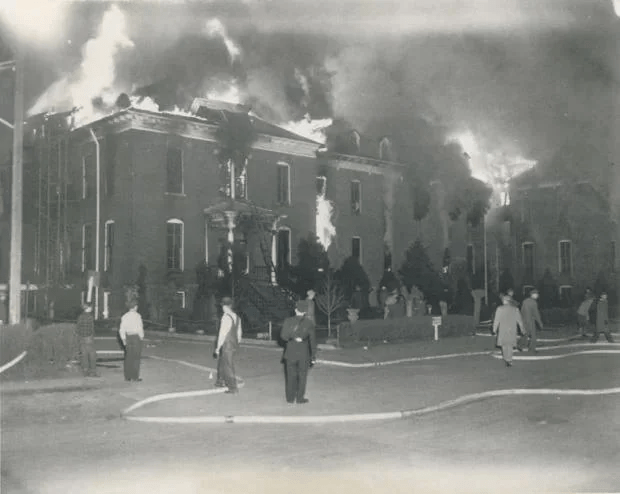
The Second Ground: Sheboygan Proper (1882–1940)
The 1882 move was meant to be practical. Higher ground, better access, and distance from the old rumors. The new facility between Superior and Erie Avenues never worked purely as a hospital. It became a holding place for the insane, the poor, the unwanted, and the inconvenient.
Another fire hit on December 29, 1892. More deaths, still no explanation. The same strange aftermath followed. Survivors felt as though they had been counted. Staff heard voices that carried no words, only pressure. Patients often settled not from care, but when placed in certain isolated wings.
By 1911 the institution spread across more than 300 acres. Officially it supported farming, self-sufficiency, and growth. Unofficially, staff half-joked that the extra land existed to swallow sound.
“If it were smaller,” one nurse reportedly said, “the nights would hear us.”
The idea took root that something had followed the institution from Winooski. Or worse, that all the repeated suffering had summoned it. Two fires. Two clusters of unexplained deaths. Two places where pain was concentrated and then buried.
When they demolished the buildings in 1940, the graves stayed. Standard procedure. Efficient. Unremarkable on paper. What paperwork ignores is not always ignored by whatever listens.
Today commerce and healthcare fill the site. People still mention sudden disorientation in the parking lot, losing track of time inside stores, or an unplaceable dread near closing. Few linger after dark if they can help it.
The Third Ground: Sheboygan Falls (1940–Present)
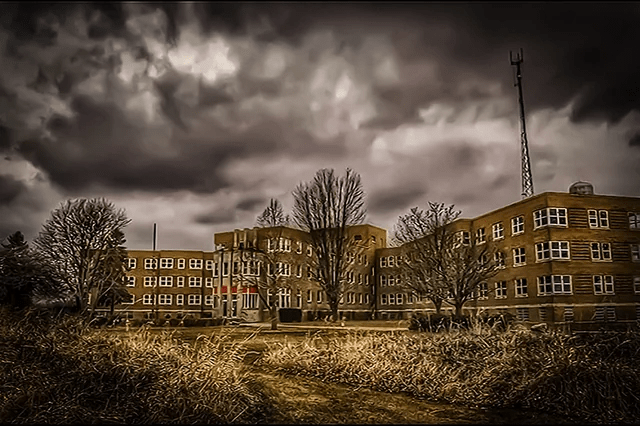
The Sheboygan Falls facility is the one people talk about now. The one investigators bring equipment to. The one with photos, recordings, and stories traded like currency.
Compared to the earlier sites, it feels louder. That makes it deceptive.
Built in 1940, it absorbed suffering out in the open. Neglected elderly, warehoused disabled, restrained mentally ill. When the Department of War took it over during World War II, the cruelty did not worsen. It simply became official.
Minimal care was policy, not an accident.
The suicides, both recorded and rumored, share a peculiar pattern. Many happened in transitional spaces. Stairwells, doorways, thresholds that were neither fully inside nor out. Investigators often describe these spots as crowded even when empty.
Unlike the older grounds, this one does not feel occupied so much as saturated.
Those who investigate long enough notice something else. Activity increases not during provocation, but in quiet moments. When no one is hunting for evidence. When attention drifts.
As if whatever lingers has grown tired of performing.
The Throughline: What Was Never Named
The pattern across all three sites does not fit conventional haunting. There is no single tragedy at its center. No defining atrocity.
What appears instead is convergence. Repeated fires with no clear cause. Institutions built to isolate and contain despair. Grounds reused without cleansing or acknowledgment. Graves left in place. Identities erased.
Among the most experienced investigators, the common view is that the land did not create the presence. The institutions fed it.
Not a demon. Not a traditional spirit. Something closer to a pressure system. Drawn to prolonged despair, strengthened by secrecy, and reinforced every time suffering was hidden instead of faced.
The Falls site still murmurs because it is recent enough to hold memory. The older grounds stay silent because they no longer need to speak.
 Eric Roseberry | Builder of Nightmares